
Full-time workplace work is ‘useless,’ economist says
Morsa Photos | Digitalvision | Getty Photos
Employees and firms see advantages of distant work
In 2019, about 5% of full-time work was achieved from house. The share ballooned to greater than 60% in April and Might 2020, within the early days of the Covid-19 pandemic, stated Nicholas Bloom, an economist at Stanford College who has researched distant work for twenty years.
That is the equal to nearly 40 years of pre-pandemic progress just about in a single day, his analysis exhibits.
The share of distant work has steadily declined (to about 27% at the moment) however is prone to stabilize round 25% — a fivefold improve relative to 2019, Bloom stated.
“That is enormous,” he stated. “It is nearly not possible to seek out something in economics that adjustments at such velocity, that goes up by 500%.”
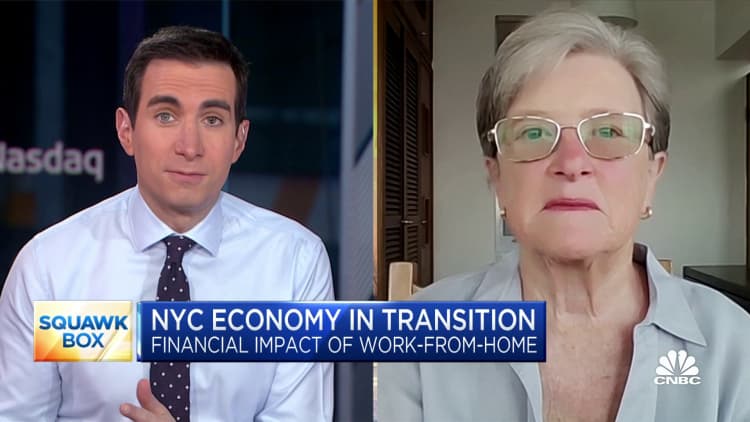
Initially, distant work was seen as a needed measure to comprise the unfold of the virus. Technological advances — like video conferencing and high-speed web — made the association attainable for a lot of employees.
Each staff and firms subsequently found advantages past well being impression, economists stated.
Staff most benefit from the discount in commute, much less time preparing for work, and a versatile schedule that extra simply permits for physician visits and selecting up youngsters from faculty, Bloom stated.
Some employees have proven they’re reluctant to relinquish these perks. Firms like Amazon and Starbucks, for instance, not too long ago confronted a backlash from staff after saying stricter return-to-office insurance policies.
Employers get pleasure from greater worker retention and may recruit from a broader pool of candidates, stated Julia Pollak, chief economist at ZipRecruiter. They’ll lower your expenses on workplace area, by recruiting from lower-cost areas of the nation, or by elevating wages at a slower tempo as a result of employees’ perceived worth of the work-at-home profit, she stated.
It is nearly not possible to seek out something in economics that adjustments at such velocity.
Nicholas Bloom
economist at Stanford College
For instance, job seekers polled by ZipRecruiter say they’d be ready to take a 14% pay minimize to work remotely, on common. The determine skews greater — to about 20% — for fogeys with younger youngsters.
Twitter not too long ago shut its Seattle places of work as a cost-cutting measure and instructed staff to do business from home, a reversal from an earlier place that staff work at the least 40 hours every week within the workplace.
“The advantages for employers are fairly substantial,” Pollak stated.
Hybrid work mannequin is a ‘win-win’
Momo Productions | Digitalvision | Getty Photos
Most corporations have turned to a “hybrid” mannequin, with a piece week cut up perhaps two days from house and three within the workplace, economists stated.
That association has yielded a slight enhance in common employee productiveness, Bloom stated. For one, the common individual saves 70 minutes a day commuting; roughly half-hour of that point financial savings is spent working extra, he stated.
“Hybrid is just about a win-win,” Bloom stated.
About 39% of recent hires have jobs with a hybrid work association, whereas 18% of recent jobs are absolutely distant, based on ZipRecruiter. Each shares are up relative to their pre-pandemic ranges (28% and 12%, respectively).
“It is nonetheless an evolving development, however the motion may be very a lot towards elevated distant work,” Pollak stated.
In fact, not all employees have the choice. About 37% of jobs within the U.S. can plausibly be achieved completely at house, based on a 2020 examine by Jonathan Dingel and Brent Neiman, economists on the College of Chicago.
There are massive variations by occupation and geography. For instance, jobs in retail, transportation, hospitality and meals companies are far much less seemingly than these in expertise, finance, {and professional} and enterprise companies to supply work-from-home preparations.
Distant work might endure even in a recession
Not everybody agrees that the advantages of working from house outweigh prices.
Proof suggests worker mentoring, innovation and firm tradition might endure if jobs are absolutely distant, Bloom stated. Employees cite face-to-face collaboration, socializing and higher work-life steadiness as high advantages of in-office work, his analysis finds.
Firms which might be absolutely distant usually have in-person gatherings or retreats as a option to construct firm tradition, Bloom stated.

Employees have loved a excessive diploma of bargaining energy as a result of a sizzling labor market characterised by low unemployment and ample job openings. If the financial system cools and their bargaining energy dissipates, it is unclear whether or not some employers would introduce stricter work-from-home insurance policies, economists stated.
For one, employers might even see distant work as a helpful methods to trim labor prices within the face of recession, Bunker stated. The extra seemingly situation is on the margin: maybe three or 4 days within the workplace as an alternative of 1 or two, he stated.
The expertise sector is a helpful indicator, he stated. Tech job postings have fallen this 12 months amid trade struggles, however the share of Certainly job advertisements providing the distant work profit has remained fixed, Bunker stated.
“It has been fairly sticky within the face of hiring pullbacks,” he stated.


