Silicon Valley Financial institution prospects scramble to satisfy payroll, pay payments
The sudden collapse of Silicon Valley Financial institution has hundreds of tech startups questioning what occurs now to their thousands and thousands of {dollars} in deposits, cash market investments and excellent loans.
Most significantly, they’re attempting to determine the way to pay their staff.
“The primary query is, ‘How do you make payroll within the subsequent couple days,'” stated Ryan Gilbert, founding father of enterprise agency Launchpad Capital. “Nobody has the reply.”
SVB, a 40-year-old financial institution that is recognized for dealing with deposits and loans for hundreds of tech startups in Silicon Valley and past, fell aside this week and was shut down by regulators within the largest financial institution failure because the monetary disaster. The demise started late Wednesday, when SVB stated it was promoting $21 billion of securities at a loss and attempting to boost cash. It become an all-out panic by late Thursday, with the inventory down 60% and tech executives racing to tug their funds.
Whereas financial institution failures aren’t totally unusual, SVB is a singular beast. It was the sixteenth largest financial institution by property on the finish of 2022, in accordance with the Federal Reserve, with $209 billion in property and over $175 billion in deposits.
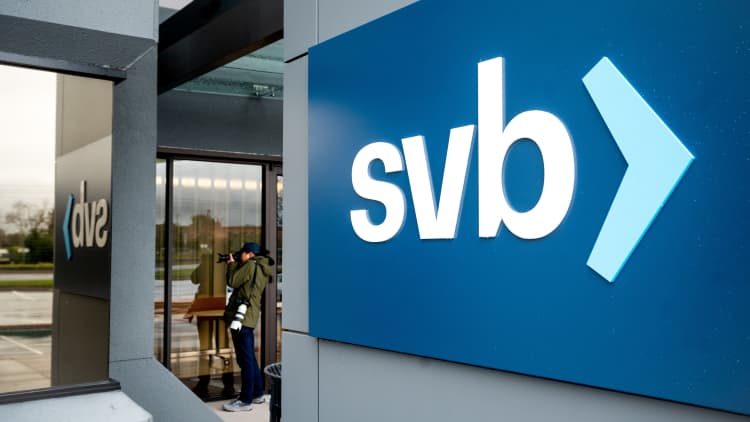
Staff stand exterior of the shuttered Silicon Valley Financial institution (SVB) headquarters on March 10, 2023 in Santa Clara, California.
Justin Sullivan | Getty Photos
Nonetheless, in contrast to a typical brick-and-mortar financial institution — Chase, Financial institution of America or Wells Fargo — SVB is designed to serve companies, with over half its loans to enterprise funds and personal fairness corporations and 9% to early and growth-stage corporations. Purchasers that flip to SVB for loans additionally are inclined to retailer their deposits with the financial institution.
The Federal Deposit Insurance coverage Company, which turned the receiver of SVB, insures $250,000 of deposits per shopper. As a result of SVB serves largely companies, these limits do not imply a lot. As of December, roughly 95% of SVB’s deposits have been uninsured, in accordance with filings with the SEC.

The FDIC stated in a press launch that insured depositors could have entry to their cash by Monday morning.
However the course of is rather more convoluted for uninsured depositors. They will obtain a dividend inside per week masking an undetermined quantity of their cash and a “receivership certificates for the remaining quantity of their uninsured funds.”
“Because the FDIC sells the property of Silicon Valley Financial institution, future dividend funds could also be made to uninsured depositors,” the regulator stated. Usually, the FDIC would put the property and liabilities within the palms of one other financial institution, however on this case it created a separate establishment, the Deposit Insurance coverage Nationwide Financial institution of Santa Clara (DINB), to care for insured deposits.
Purchasers with uninsured funds — something over $250,000 — do not know what to do. Gilbert stated he is advising portfolio corporations individually, as a substitute of sending out a mass electronic mail, as a result of each scenario is totally different. He stated the common concern is assembly payroll for March 15.
Gilbert can also be a restricted associate in over 50 enterprise funds. On Thursday, he obtained a number of messages from corporations relating to capital calls, or the cash that traders within the funds ship in as transactions happen.
“I obtained emails saying saying do not ship cash to SVB, and you probably have tell us,” Gilbert stated.
The considerations relating to payroll are extra advanced than simply gaining access to frozen funds, as a result of a lot of these companies are dealt with by third events that have been working with SVB.
Rippling, a again office-focused startup, handles payroll companies for a lot of tech corporations. On Friday morning, the corporate despatched a be aware to purchasers telling them that, due to the SVB information, it was shifting “key parts of our funds infrastructure” to JPMorgan Chase.
“It is advisable inform your financial institution instantly about an essential change to the best way Rippling debits your account,” the memo stated. “If you don’t make this replace, your funds, together with payroll, will fail.”
Rippling CEO Parker Conrad stated in a collection of tweets on Friday that some funds are getting delayed amid the FDIC course of.
“Our prime precedence is to get our prospects’ staff paid as quickly as we probably can, and we’re working diligently towards that on all out there channels, and attempting to be taught what the FDIC takeover means for at present’s funds,” Conrad wrote.
One founder, who requested to stay nameless, instructed CNBC that everybody is scrambling. He stated he is spoken with greater than 30 different founders, and talked to a finance chief from a billion-dollar startup who has tried to maneuver greater than $45 million out of SVB to no avail. One other firm with 250 staff instructed him that SVB has “all our money.”
A SVB spokesperson pointed CNBC again to the FDIC’s assertion when requested for remark.
‘Vital contagion danger’
For the FDIC, the speedy aim is to quell fears of systemic danger to the banking system, stated Mark Wiliams, who teaches finance at Boston College. Williams is kind of conversant in the subject in addition to the historical past of SVB. He used to work as a financial institution regulator in San Francisco.
Williams stated the FDIC has at all times tried to work swiftly and to make depositors complete, even when when the cash is uninsured. And in accordance with SVB’s audited financials, the financial institution has the money out there — its property are larger than its liabilities — so there is not any obvious cause why purchasers should not have the ability to retrieve the majority of their funds, he stated.
“Financial institution regulators perceive not shifting shortly to make SVB’s uninsured depositors complete would unleash important contagion danger to the broader banking system,” Williams stated.
Treasury Secretary Janet Yellen on Friday met with leaders from the Federal Reserve, the FDIC, and the Workplace of the Comptroller of the Forex relating to the SVB meltdown. The Treasury Division stated in a readout that Yellen “expressed full confidence in banking regulators to take applicable actions in response and famous that the banking system stays resilient and regulators have efficient instruments to handle this sort of occasion.”
On the bottom in Silicon Valley, the method has been removed from clean. Some execs instructed CNBC that, by sending of their wire switch early on Thursday, they have been capable of efficiently transfer their cash. Others who took motion later within the day are nonetheless ready — in some circumstances, for thousands and thousands of {dollars} — and are unsure if they’re going to have the ability to meet their near-term obligations.
No matter if and the way shortly they’re capable of get again up and working, corporations are going to vary how they consider their banking companions, stated Matt Brezina, a associate at Ford Avenue Ventures and investor in startup financial institution Mercury.
Brezina stated that after payroll, the largest situation his corporations face is accessing their debt amenities, notably for these in monetary expertise and labor marketplaces.
“Corporations are going to finish up diversifying their financial institution accounts rather more popping out of this,” Brezina stated. “That is inflicting numerous ache and complications for plenty of founders proper now. And it should hit their staff and prospects too.”
SVB’s fast failure may additionally function a wakeup name to regulators in the case of coping with banks which are closely concentrated in a specific business, Williams stated. He stated that SVB has at all times been overexposed to tech though it managed to outlive the dot-com crash and monetary disaster.
In its mid-quarter replace, which started the downward spiral on Wednesday, SVB stated it was promoting securities at a loss and elevating capital as a result of startup purchasers have been persevering with to burn money at a fast clip regardless of the continued droop in fundraising. That meant SVB was struggling to keep up the mandatory stage of deposits.
Somewhat than sticking with SVB, startups noticed the information as troublesome and determined to hurry for the exits, a swarm that gained power as VCs instructed portfolio corporations to get their cash out. Williams stated SVB’s danger profile was at all times a priority.
“It is a concentrated guess on an business that it should do properly,” Williams stated. “The liquidity occasion wouldn’t have occurred in the event that they weren’t so concentrated of their deposit base.”
SVB was began in 1983 and, in accordance with its written historical past, was conceived by co-founders Invoice Biggerstaff and Robert Medearis over a poker sport. Williams stated that story is now extra applicable than ever.
“It began as the results of a poker sport,” Williams stated. “And that is type of the way it ended.”
— CNBC’s Lora Kolodny, Ashley Capoot and Rohan Goswami contributed to this report.
WATCH: SVB fallout may imply much less credit score is offered